
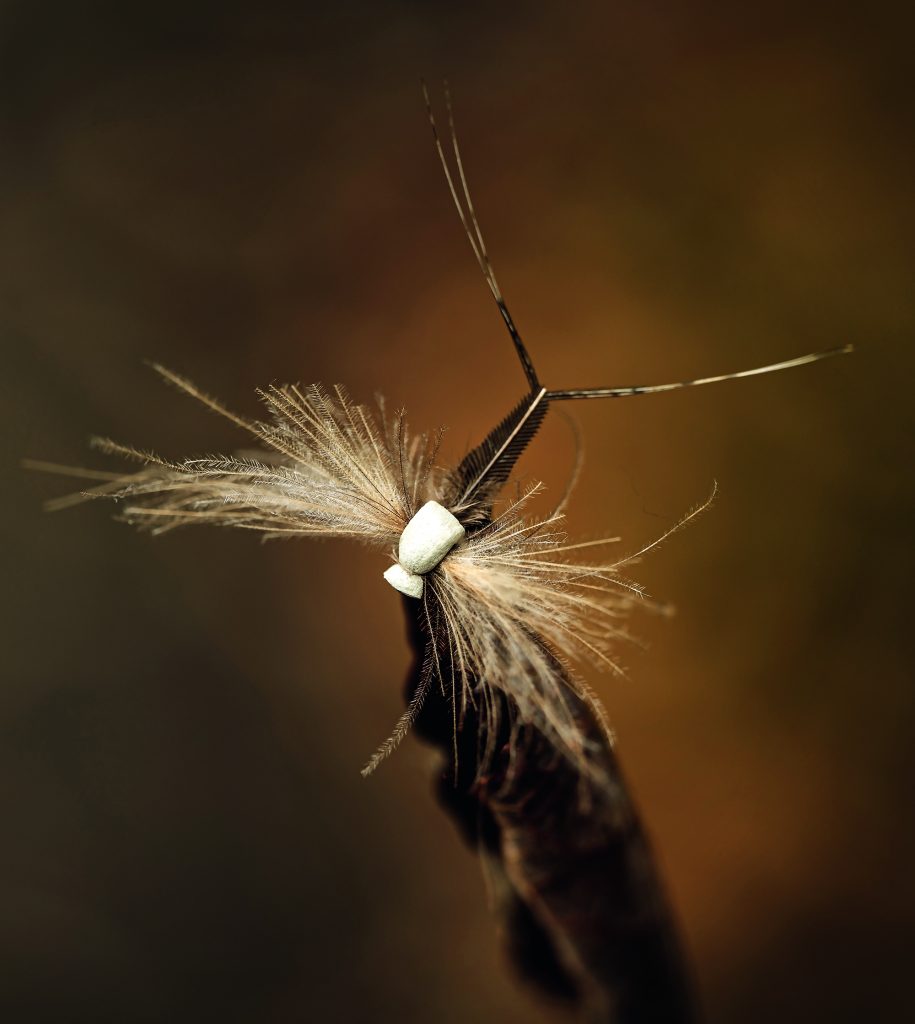
Simple and effective dry fly:
Dry fly fishing in Denmark is not quite as gloomy an experience as some rumours make it out to be. There are both beautiful trout and fine streams to be found out there for the seeking fly fisherman. Stuff some simple and effective CDC flies into the box and get ready to extend your season with the fly rod.
By Peter Lyngby
(this artickle has been published in the danish magazine “Sportsfiskeren”)

The glossy image of Danish dry fly fishing is massive hatches of eye-catching mayflies on a warm early summer day. The river’s trout cast their inhibitions and smack uncritically in large Ephemera Danica mayflies. These fantastic days still occur in some Danish watercourses, but unfortunately the far more common absence of the phenomenon means that some fly fishermen label the season as bad, after only a few unsuccessful trips. Or even more bluntly, completely drop dry fly fishing. However, interviews with inveterate dry fly fishermen indicate that the battle is not lost and that it is a mistake to write off the possibilities with the light fly tackle. For the persistent and outgoing fly fisherman, the rivers still have a lot of interesting dry fly fishing to offer.

Once upon a time,
The aquatic environment in some of our watercourses has definitely been better than it is now. The same applies to many rivers’ populations of brown trout. Therefore, unfortunately, the misconception has spread that good brown trout fishing is a thing of the past. When several rivers are condemned out, it is natural to get the impression that there is generally nothing at all to fall after. Not all fly fishermen are equally outreaching, and some dry fly fishermen have ended up at home on the couch with the corners of their mouths down.
Our brown trout stocks may not be huge, but it is actually possible to find day-card stretches, where you can strangely walk alone with the dry fly rod on a late summer evening. And at the same time, lure well-fed brown trout to the surface. Reliable sources refer to 40-60 centimeter fish as if they are not among the rarities on dry flies.
But neither the streams nor the fishing stretches are necessarily the old recognized dry fly waters. Some have put time into finding the fish in other and new places, and now they may no longer be quite so big with their arms when it comes to where and how. The brown trout stocks are fragile, and a number of dry fly fishermen keep their cards close to their chests. They know that the trout are not numerous enough to tolerate repatriation, so they are content to practice surface fishing in all quietness, and otherwise release all the fish carefully again.
In other words, the good dry fly fishing still exists in Denmark, but it flies low and often completely under the radar, so you should set aside time to find the fish and the productive waters.
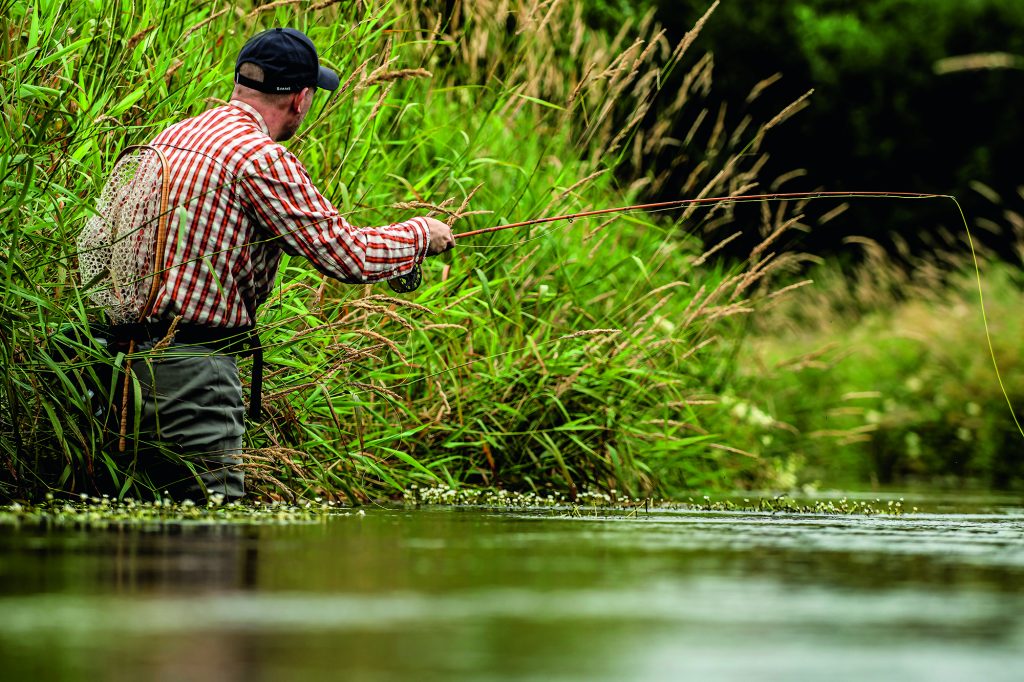
Extend the season
When the opportunities for dry fly fishing do not look completely black, you might as well optimize the opportunities and the season, and not just settle for the few hectic days when the hatchlings get all the trout on the surface course. Some purists believe that the essence of dry fly fishing is to cast to ringing fish, and that everything else must be categorized as cheating. Or worse. If you do not look at fly fishing quite so chastely, you can actually lure many fish to the surface, even if they may not ring quite as steadily and continuously as the textbooks describe. Once you know your stream and some of the fish’s spots, you can even catch fine trout on regular blind fishing. Just think of the up-and-coming surface fishing for sea trout in both the rivers and on the coast. For the same reason, you should think about the dry fly season longer than just May and the summer months. The good days in the high season can be good for locating the river’s pitches, but it is easy to experience surface activity long before. Even in October, you can meet ringing fish. It’s possible that you won’t see more than four fish calling in a day at that time of year, but that doesn’t mean you can’t easily have contact with five fish or more.
Out at dusk
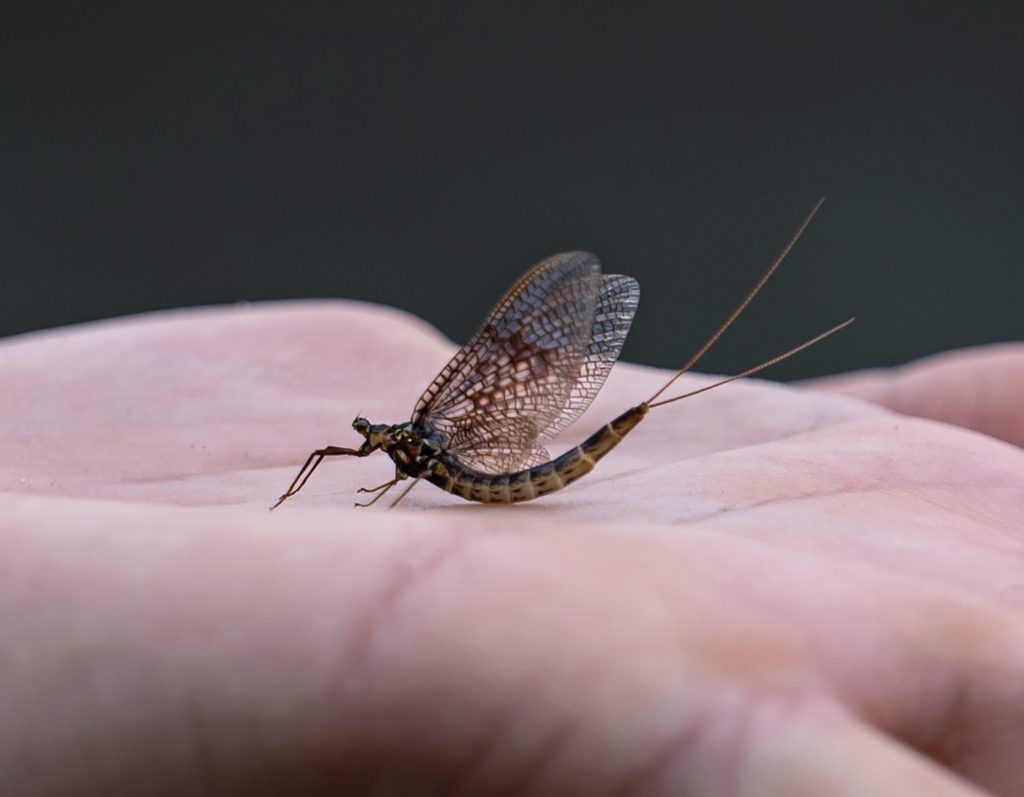
The last part of the day is a good time to head out with the dry fly rod. Often the wind dies down during the evening, and when the bright light disappears, the fish are usually less shy. If there have been hatches of mayflies during the day, you get the so-called spinner drop into the bargain, where dead and dying insects drift defenseless with the current. The spinner drop is a treat for those trout that are not already full. The good evening conditions also benefit the frequency of trips to the river. Where it can be difficult to squeeze in a morning walk, you more often have the opportunity for a few evening hours during the week.
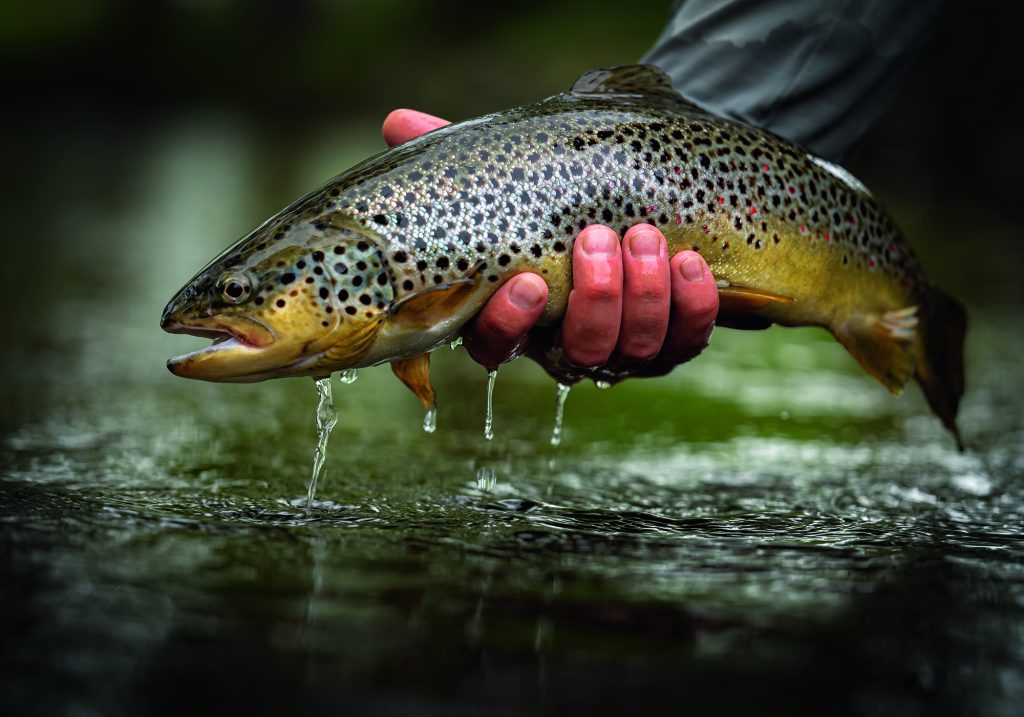
However, twilight fishing is not all advantages. The dimmer light may lure some shy fish out, but the lack of light does not make it any easier to be a dry fly fisherman. You should park the traditional mindset that dry flies should be fished upstream, along with the car. Fish instead, where you have the best light and view of the fishing spot. Whether it’s upstream or downstream. Otherwise, it can be difficult to see a size 16 on the surface at dusk. Fortunately, flies that small are not always needed, and at dusk, larger strap-flies, muddlers or imitations of daddy-long-legs are often the thing.
All fishing can be made into a science, and some dry fly fishermen have an enormous knowledge of entomology and the world of insects. However, smaller can also do it, and if you start fishing by having a cup of coffee on the river bank, you will soon get an idea of which insects are on the wings. Or on the surface. Maybe you have no idea about their Latin name or family, but you can still catch a trout on a dry fly that looks something like that. At dusk, size and shape are usually enough to make the difference.

Peter Wigdell behind the vise – ready to tie a Wigdell’s CDC Spent.
Wigdell’s CDC Spent
Flies that imitate insects in the spinner stage are a whole genre of their own among dry flies. They are called Spent-flies in English. The fly type is characterized by the wings lying transversely and flat, in the same plane as the hook shaft, as opposed to the upright dry fly wings.
Fly tyer Peder Wigdell has created a well-catching spent, which is an excellent choice when it comes to a simple go-to model for the fly box. Wigdell’s CDC Spent is a stylish and fishy dry fly that can imitate many different mayflies in the spinner stage. CDC Excited works well in sizes 8-18, depending on which mayfly is imitated. The color combination shown is a good starting point, but colors and partly proportions can be fine-tuned in the direction of the exact insect.
In addition to being simple to tie, Wigdell’s CDC Spent excels at being easy to cast. The fly lands well on the water, and it is easy to see in the waning light, as it has quite a visible foam vest on.
The CDC feathers themselves are the challenge, as they, like many other natural materials, are not always easy to find in a good quality. The trick is to use the right size feather for the right size fly. On the smallest CDC Spent-flies, you usually have to trim the feathers a little with scissors, while it can be difficult to dust up large enough CDC feathers for the largest flies.
Cul de Canard (CDC)
CDC is an abbreviation of cul de canard, which translated from French means something like the bottom of the duck. This refers to the fact that the CDC feathers sit close to a gland that many bird species have sitting just below the tail feathers. The gland releases a water-repellent oil. The bird can reach the gland with its beak, and in this way use the oil to impregnate certain parts of the plumage itself. This is a very special oil, and it is worth remembering as a dry fly fisherman. When you want to re-impregnate a CDC fly, you need to use oils made for the purpose, while a spray for hackle flies, for example, can even risk destroying the CDC feathers.
In the fly tying, CDC feathers spread like wildfire out of Central Europe in the late 1990s, and around the turn of the millennium, several good books on the subject appeared. A little later, CDC feathers came into fashion and had to be used in any dry fly for a while. Swiss Marc Petitjean’s 500-page book “CDC” is considered to be the bible of the genre.
As mentioned, the CDC market is fluctuating, and if you want to tie with the CDC, the best advice is to buy them immediately if you come near good quality feathers. The feathers for fly tying only appear as a by-product from other poultry breeding, and therefore there can be large fluctuations in quality and deliveries. A good CDC feather has almost all of its bee rays, and in an ideal world, you might be able to make do with a single CDC feather for a fly like Wigdell’s CDC Spent. However, such perfect feathers are impossible to find. Instead, two to three feathers are added together to form the wings of the fly.
Tying tips
Peder Wigdell’s flies are generally easy to tie. If you browse the video on YouTube, the individual steps are easy to understand. In the video, you can also see how Peder handles the few materials, and how, for example, he just rounds the foam strip with a lighter, so it doesn’t appear quite as angular and fresh. Simple flies are magical, and once you’ve found the melody, you can quickly fill a few compartments in the box. In any case, you can easily reach it before spring again arrives and the river calls.
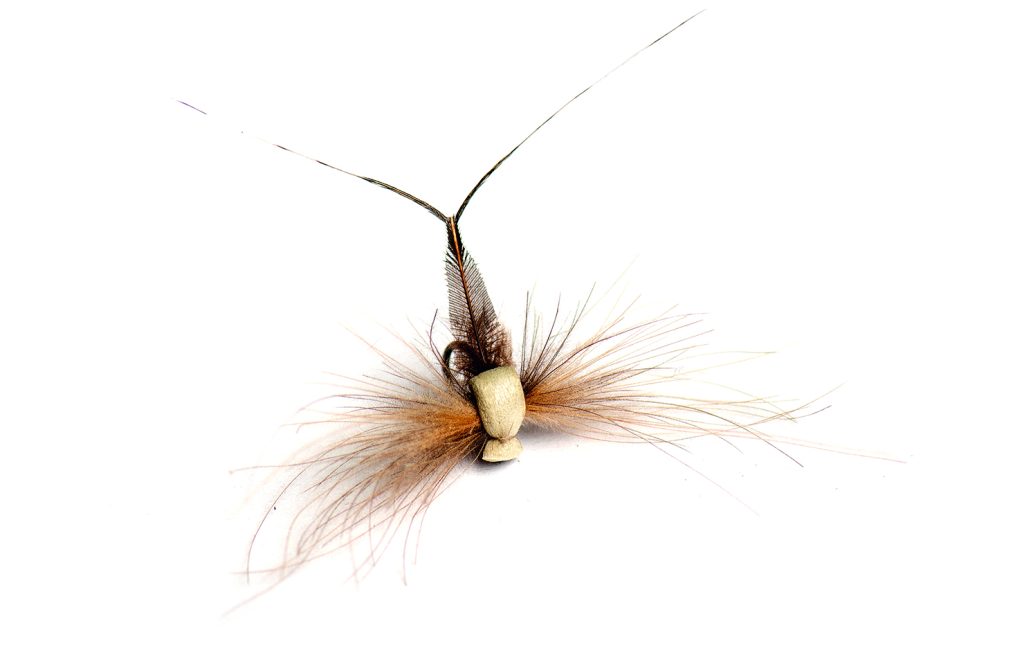
Materials
Hook: Ahrex FW525, Superdry barbless
Thread: White or Light Grey
Tail: Coq De Leon neck feather, cut to shape
Back: 2mm foam, light grey
Body: Fly-Rite, Adams Gray
Wing: CDC Feather, Natural Grey, Sand and Light Brown
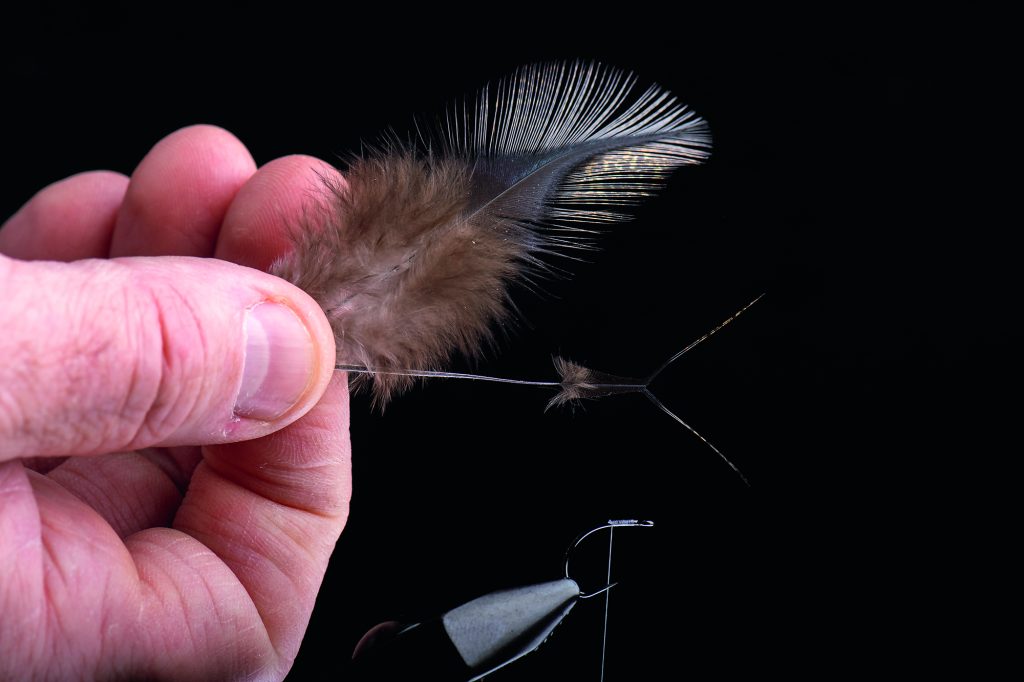
Prepare the hook in the socket and trim a Coq De Leon feather to shape the fly’s tail.
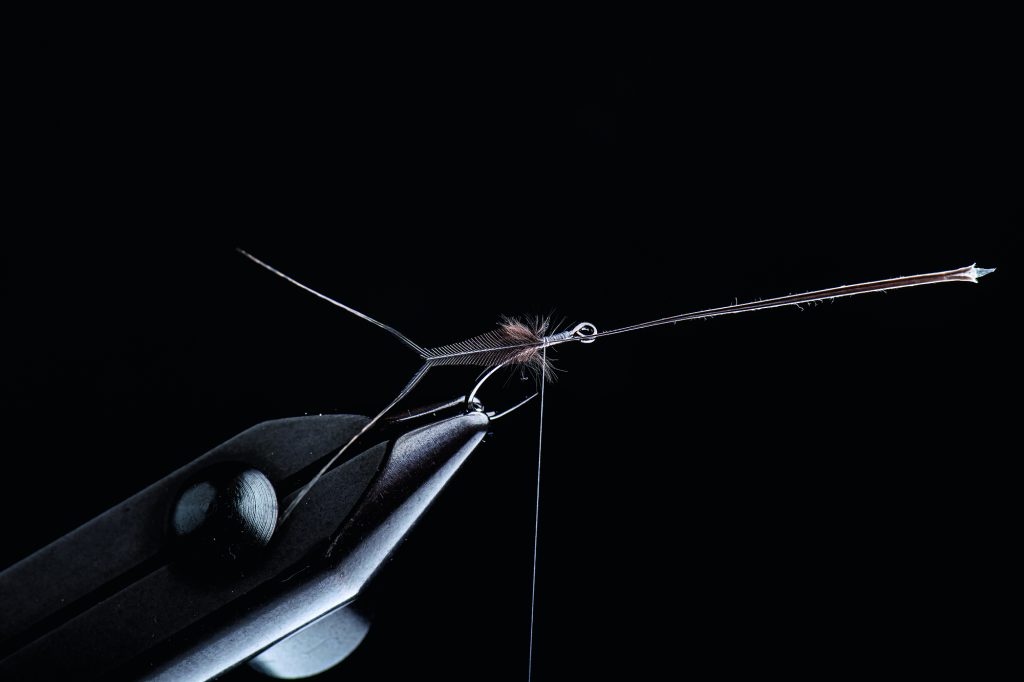
The Coq De Leon feather is tied in just above the hook tip.
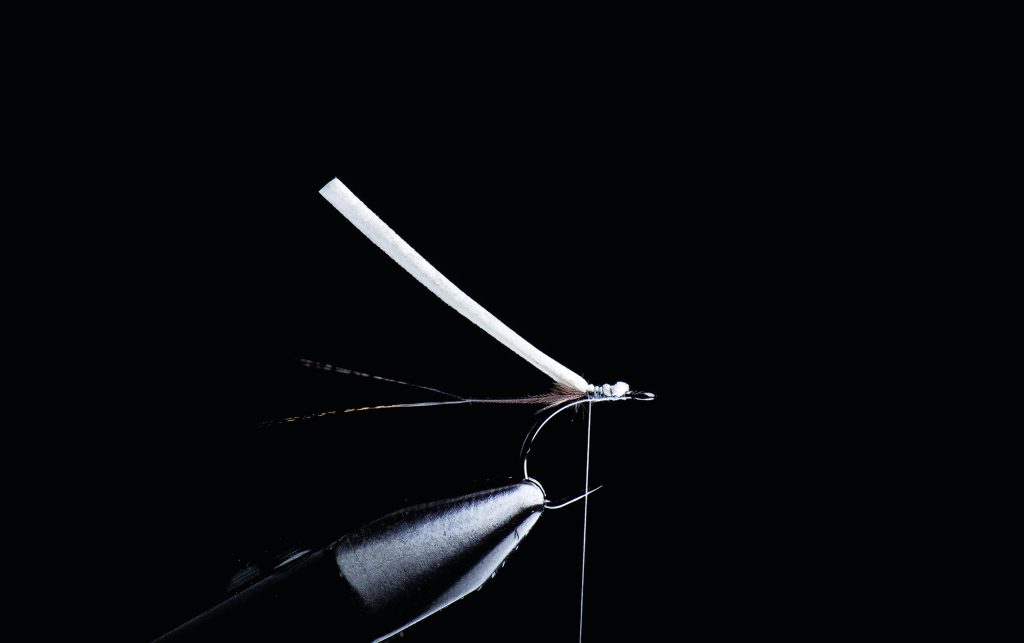
A thin strip of the grey foam is tied in along the hook shaft.
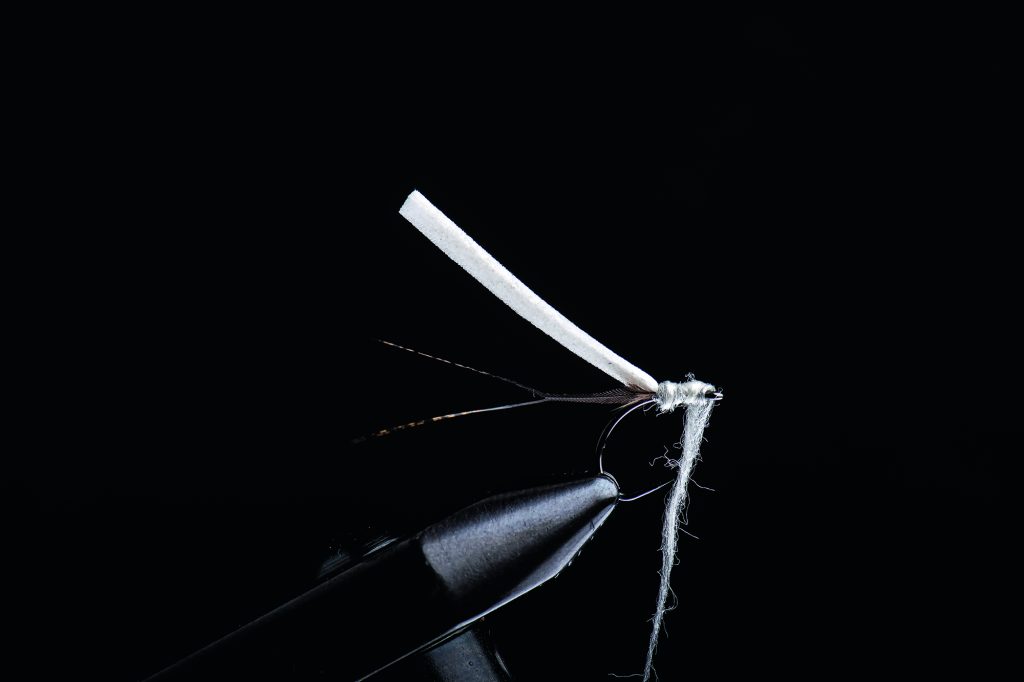
The body is dubbed with the dubbing.
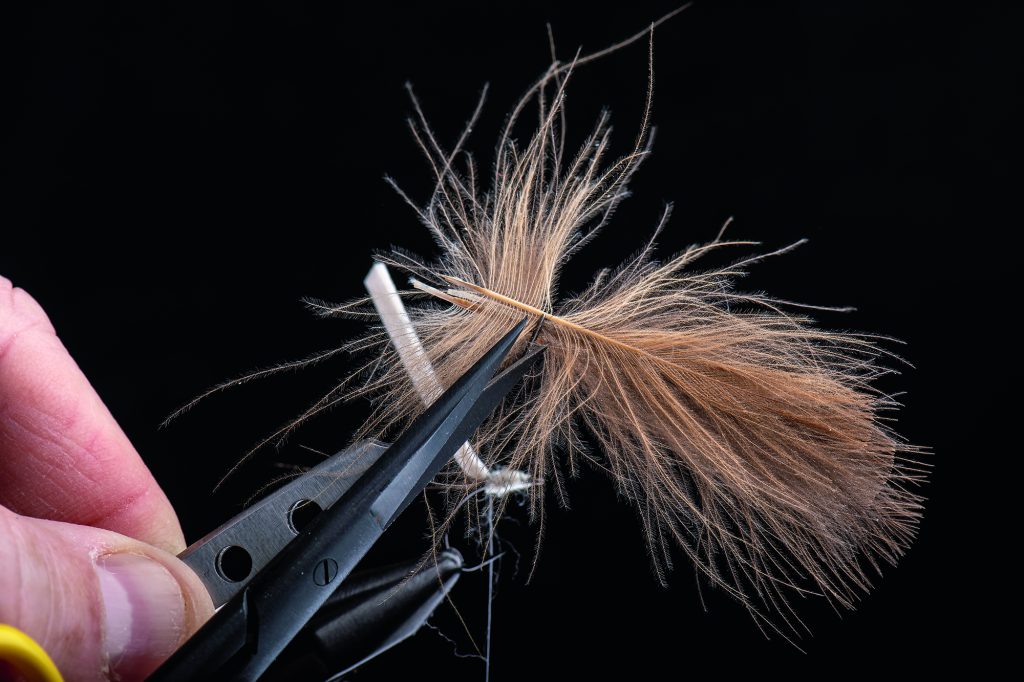
The three CDC feathers are folded together, after which they are cut.
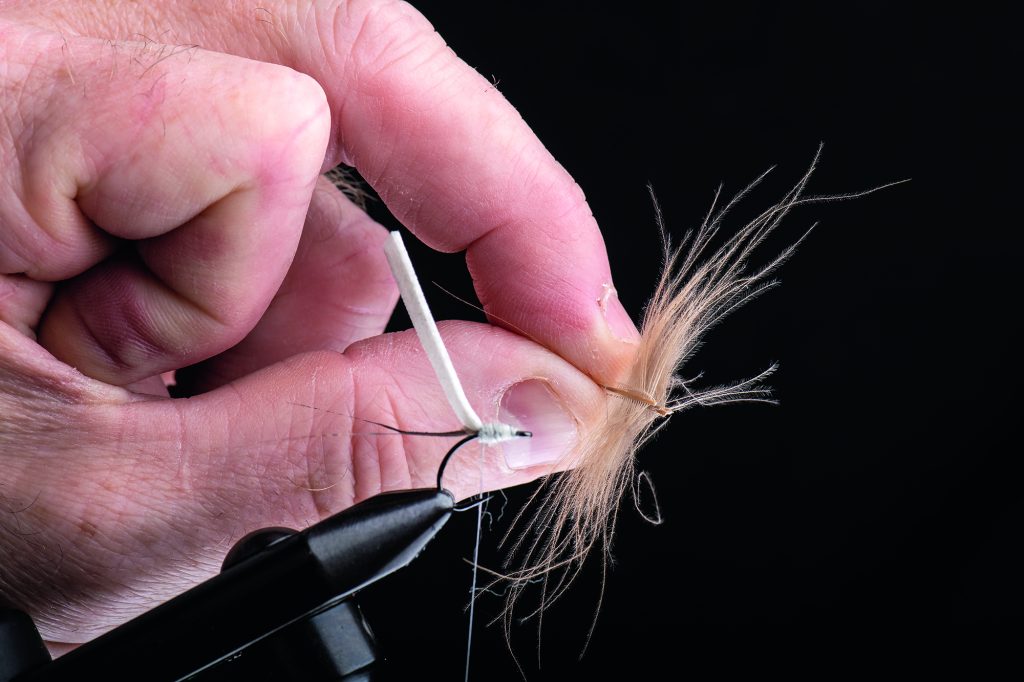
Keep the feathers close together so that they are ready for tying in.
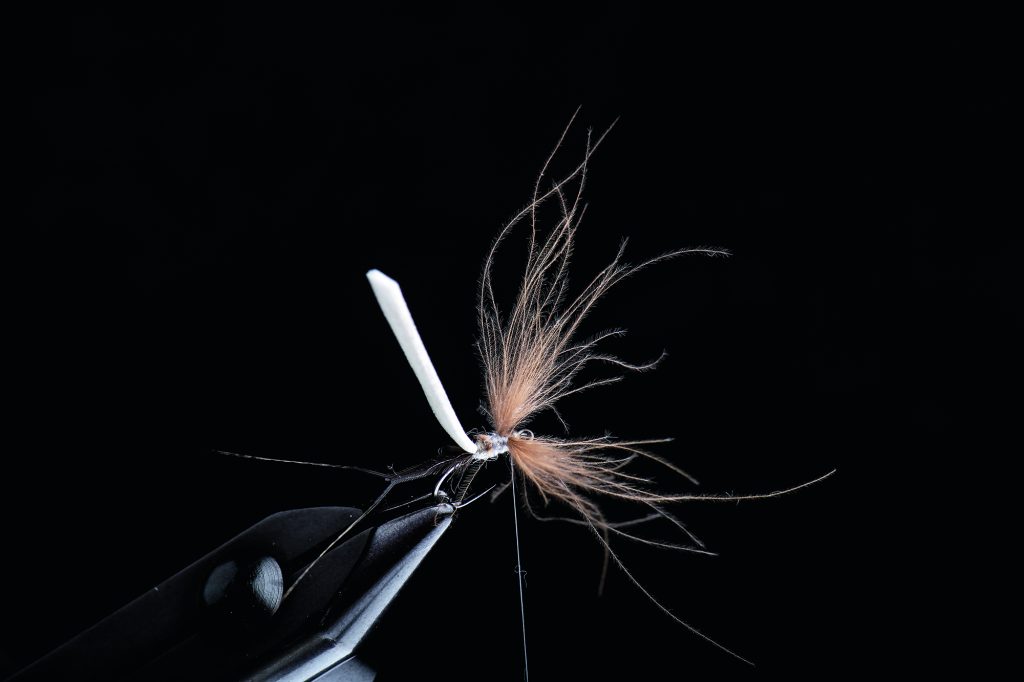
The feathers are tied in and pulled back a little before they are really tied down and split into the two wings with the thread.
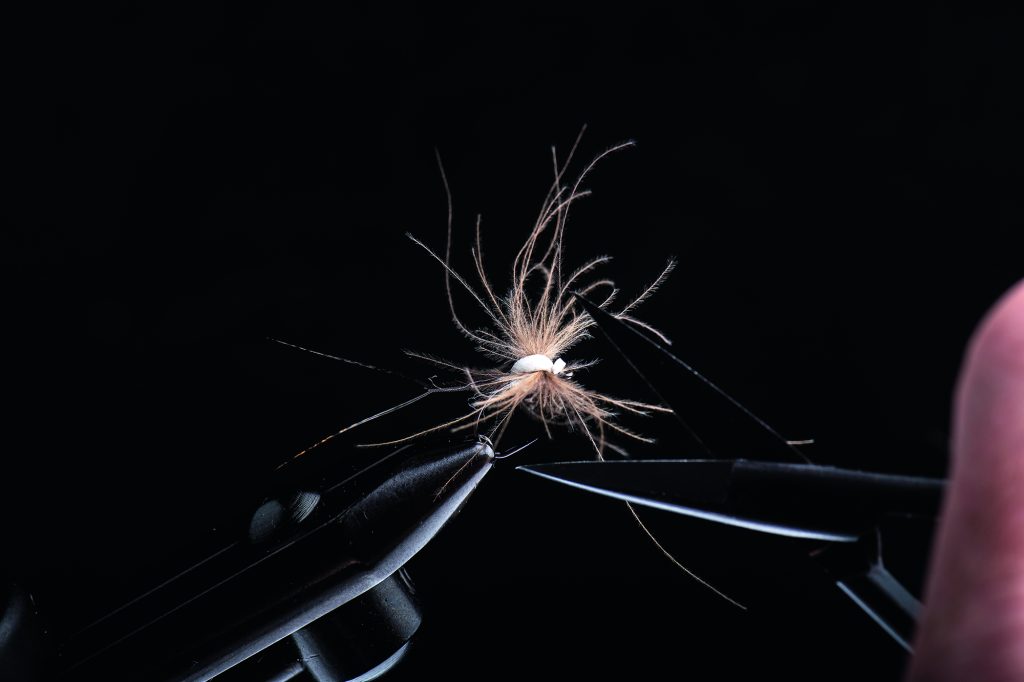
The foam strip is tilted forward between the wings and tied down. The foam is cut off just above the hook eye.
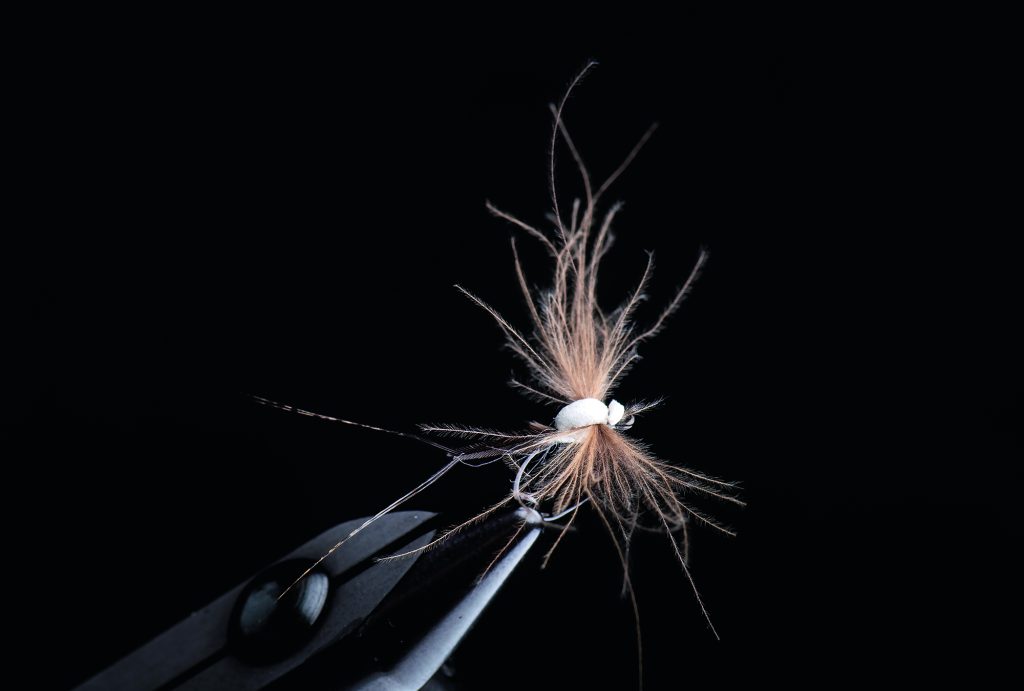
The finished fly. As a rule, it is necessary to trim individual stray CDC feather.