

Unlike mayflies and stoneflies, the caddisflies undergoes a “complete development”. The former develop from nymph to finished insect immediately, while the caddis leaves the larval stage as a pupa, which seeks to the surface or crawls on something to hatch into a finished caddis. All stages of the development are important for the fly tyer to imitate, but the pupa is in many cases the most desirable and easily accessible to the fish.
By Håkan Karsnäser
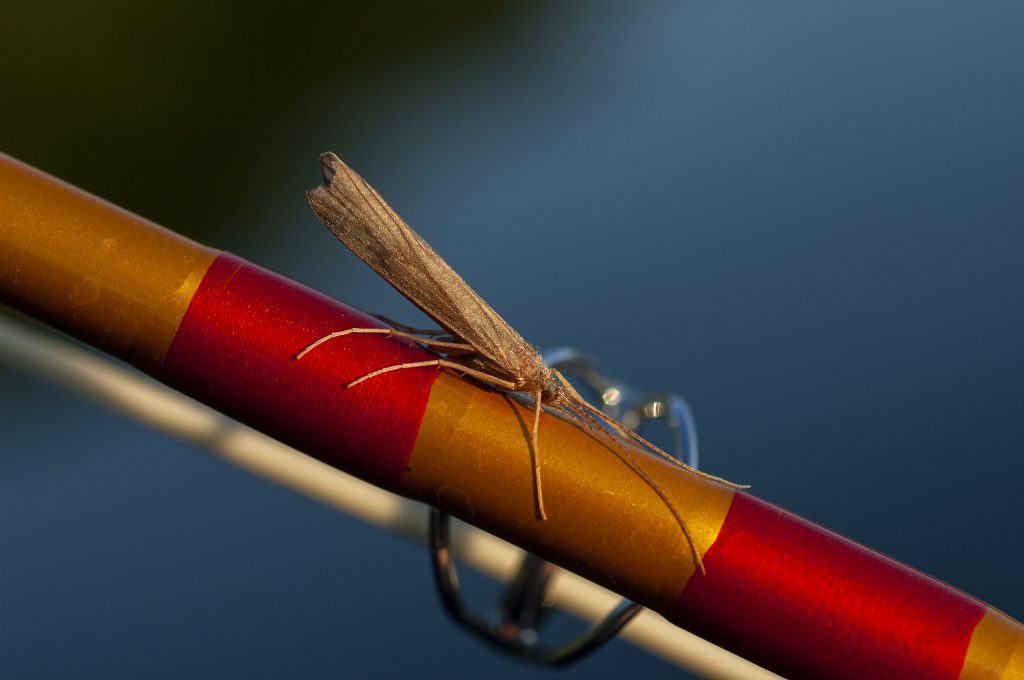
As a larva, the caddis lives on the bottom, either as a houseworm or as a free-living larva. The houseworm is most common in still water, where the larva builds a protective “house” of plant parts, sticks or grains of gravel. This is to blend in with the surroundings and camouflage themselves for predators, such as trout and rainbow trout. In flowing water, the larva lives down on the bottom where it builds catch nets between rocks to catch food that comes with the current. Sometimes they are pulled from the bottom and drift with the current, thus exposing themselves to the fish, but otherwise they live safely hidden among rocks and gravel. Before the larva becomes a caddis, it pupates on the bottom. Either in their protective house (still water) or between the gravel (flowing water).
When the caddis has become a pupa, it will then make its way up to the surface or inland and it is now that it is most exposed to hungry fish. Some species rise directly to the surface and hatch, hanging from the surface film. Others rise to the surface and then swim towards land to climb onto something and hatch there. Still others swim along the bottom towards land, before climbing up and getting out of their pupal shell. Regardless of the way they use, they are very desirable to the fish, which often reveal themselves with loud wakes at dusk. Often you see a strong movement just below the surface and then you know that the fish is hunting for swimming pupae.
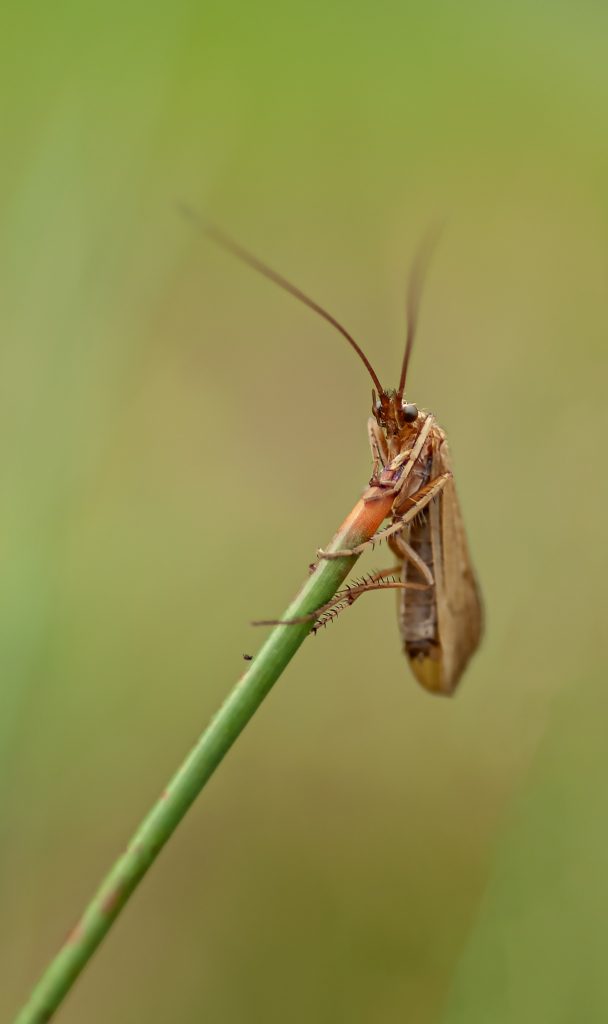
To imitate the swimming pupae, the well-known swedish fly tyer Lennart Bergqvist developed an imitation that has really made an impression on fly fishermen over the past 40 years. The fly was originally called Floating Caddis Pupa, but soon changed its name to Superpupa as a result of its success, especially with fly fishermen in flowing water with their sights set on grayling. The low-lying fly, which left a clear impression on the surface when it was brought home with short jerks, was a real success and over the years lots of color combinations have been developed.
The very popular Hökensås classic Busen, which was created by Johan Klingberg, also works great for imitating swimming caddis pupae. If you tie the fly extra fluffy and impregnate it, the fly becomes basically unsinkable. A festive moment for fly fishermen in still waters is when the largest species of caddis, Phryganea grandis , hatches. The finished spindle will be between 30-35 mm, but some loins can be up to 50 mm long. The fish do not refuse such a hearty bite and when the caddis hatches at the beginning of summer, they also attract the larger fish to the surface. A large Streaking Caddis or other Grandis imitation can then give a big boost and works just fine. However, the fish is just as happy or perhaps rather takes an imitation pupa fished on the surface, as it cannot suddenly take off and fly away.

Of course, it is perfectly possible to imitate the grandis pupa with a Buse tied to a streamer hook size 6-8, but the imitation described in this article is a good alternative and a fly that never sinks, even after a couple of fish. The pupa is usually fished with a quick hand twist or short, quick jerks of the line, which are supposed to imitate the swimming pupa. Thanks to the foam and the CdC body, you can also take the fly home with long strokes, where you pull the fly down below the surface to make the fly rise up to the surface during the break. This technique can be very effective, as the fish chases the rising chrysalis and the bites can be very explosive. Since you usually fish with these pupae at dusk or when fishing at night when the fish is not very leader shy, it can be a good idea not to go below 0.23-0.25 in leader tip.

Foampuppa Grandis
Hook: Ahrex FW 504 or FW500 size 8
Thread: black Veevus GSP 50 den or similar
Rear body: 2 natural coloured CdC feathers
Wing bag: brown foam
Thorax: hare-ear dubbing
Hackle: Partridge

Attach the thread and cover the hook shaft. Pull out the thread and make a thread loop and tie back to the hook shaft.

Select 2 natural-coloured CdC feathers and attach them to a plastic clip or Magic Tool

Take another clamp and catch all the CdC fibers. Cut off the stems.

Place the fibers in the loop, attach a dubbing twister to the end of the loop, and tighten before releasing the clip.

Twist the dubbing twister so that the fibers are stuck in the loop.

Use your fingers and dab the CdC fibers in place in the usual way.

Bring the stiffened thread up towards the hook, so that the loop twists and folds double.

Tie in the twisted CdC loop at the back of the hook, to imitate the back of the pupa. Cut out a strip of foam and tie it backwards in the same place.

Stud the thread and cover the hook shaft with hare ear dubbing.

Brush up the thorax with a piece of Velcro or similar.

Choose a long-fibre partridge hackle and attach it in front of the thorax. Wrap 2-3 rounds and fasten in and cut off the leftovers.

Fold the foam over the thorax and fasten in front of the hackle. Cut off, but leave a small piece of the foam. Finish with whip finish or half-stroke.
